- success-story
Tokić: How a next-generation autonomous mobile robot helps a leading retailer stay on top
The customer
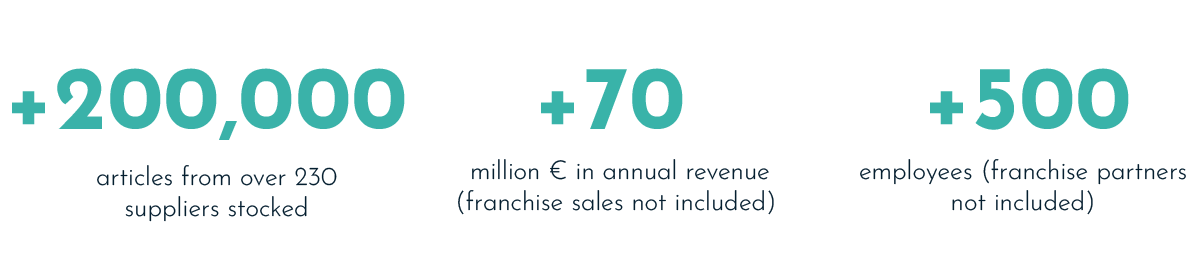
Including its franchise partners, Tokić is the largest car-parts retail chain in Croatia, with over 100 outlets. The company currently employs 500+ people, and that number rises to over a thousand when their franchise partners are included. Tokić is a licensed retailer of 230 global suppliers of parts for cars, light commercial vehicles, trucks, motorcycles and agricultural segment, as well as service workshops. They also market their retail line of products and operate a loyalty card program. In addition to retail locations, the company runs an online B2B webshop for industry professionals. The company is a member and shareholder of ATR, a global trade association, and its members are leading car-parts retailers at their home market. ATR members’ total annual revenues, from 64 markets, surpass 22.5 billion euro.
Structure
Tokić is a limited liability company founded in 1990. It is family owned, but the two founders have chosen to introduce professional management in 2014. Owners are involved in the management as supervisory board chair/members.
“Our vision is to provide – as an industry leader – the maximum contribution to the good operating condition of cars and the safety of passengers and vehicles, benefitting the entire society. We are creating a significant company that, other than making their customers happy, is also making sure our employees are content. We aim at creating a company that will be not only innovative when it comes to technology, but also traditional where it comes to respecting people. Our long-term vision is to become a regional leader, focused on exports and added-value creation.”
Challenge
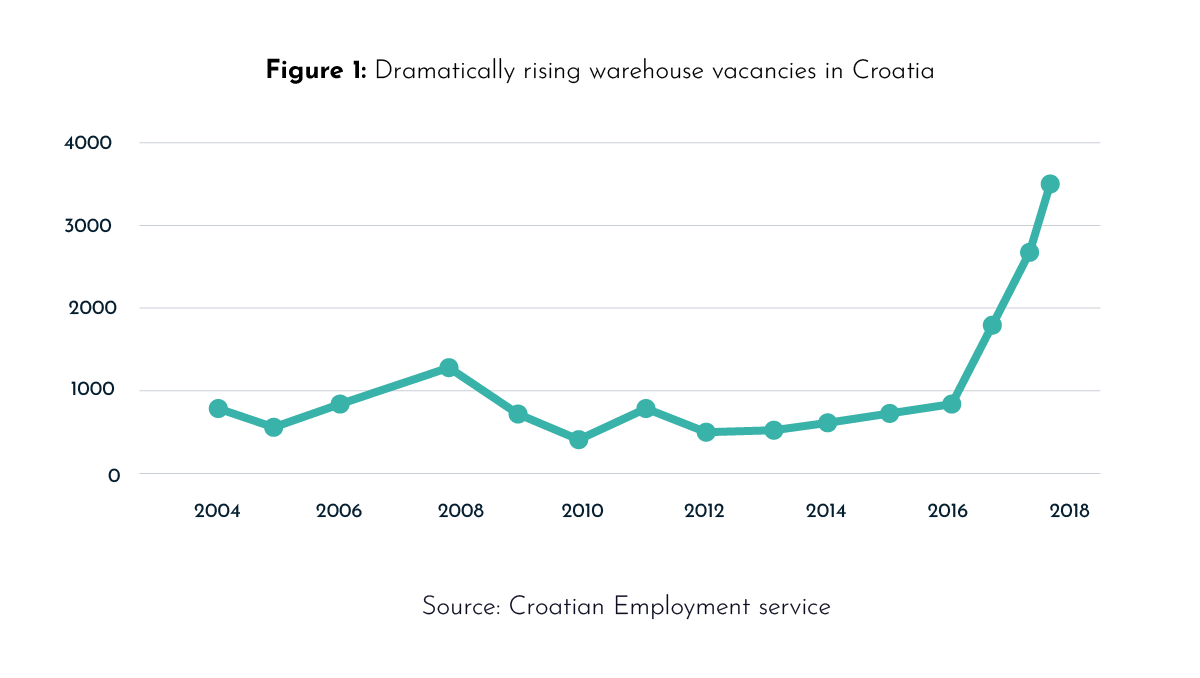
The company has been growing strongly for years, and has ambitious expansion plans on the broader EU market. This, in turn, requires increasing efficiency and addressing a lack of workforce – hitting Croatia just as it does mature markets. The company’s logistics operations are complex – they stock over 200,000 articles, which are sold through a network of corporate-owned stores and franchise outlets. Tokić’s central warehouse and distribution center near Zagreb was opened in 2016 but has already seen a surge in the volume of operations. The company has so far been able to increase its headcount to keep up with the growth, mostly by offering competitive compensation, but the management is gearing for future challenges.
Ivan Gadže, CEO of Tokić, explains that the company, as part of its plans for international expansion, is focusing not only on making sure they have skilled, experienced and satisfied employees to bring those plans to life but also on making sure they are equipped with the best tools to do the job.
“We are aware that our business environment faces the challenge of a significant labor shortage. Tokić hasn’t felt this problem so far, as employee satisfaction has been built into our values from the start. One aspect of this is the average wage, which is much higher at Tokić than the industry average. However, the labor market trends are such that we face the risk that, due to a lack of workers in the service industry, we won’t be able to grow at the rates we’ve achieved so far. A strategic approach to adapting to these market trends is an integral part of our business growth strategy, that certainly also envisages new jobs.”
Customer needs
Automation
A solution that relieves labor pressures, allowing warehouse employees to focus on valueadded tasks and reduce physically demanding and repetitive work, leading to greater job satisfaction and, consequently, lower staff turnover.
Flexible implementation
The company is looking for a solution that will allow simple and modular implementation, not requiring changes to the existing infrastructure and one that can be easily scaled as the company’s automation requirements grow.
Consistent in a highly dynamic environment
A distribution center operating at peak capacity – and in the context of a strongly expanding company gearing for further growth – is characterized by a specific set of challenges. A solution that requires a tightly controlled environment is not adequate, and the customer requires a solution that operates consistently in a highly dynamic, constantly changing setting.
Simplicity of use
Ease of use was seen as a critical requirement, not only to allow easier implementation but to address employee insecurities as well.
Solution
In late 2018, the company signed a deal for a pilot project to test Gideon’s first commercial product, the fully autonomous pallet-carrier equipped with advanced visual perception. On March 18, 2019, Tokić became the first Croatian company to implement a fully autonomous collaborative logistics robot in its warehouse.
The robot
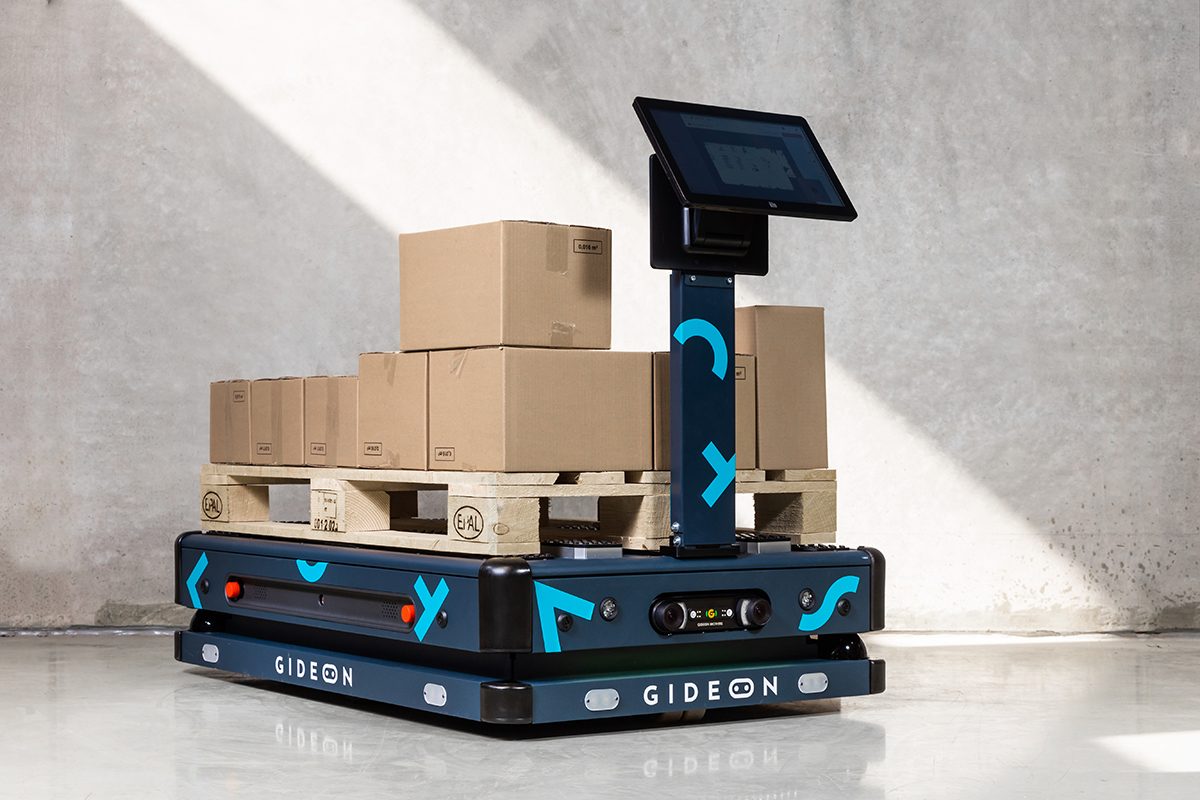
The machine is a collaborative (can work around people) logistics robot, heavy-duty pallet-carrier, with a load/lifting capacity of 800 kilograms. It is fully autonomous, requiring no guidance systems: all it needs to operate are start- and end-points on a facility map. It can also be integrated with Warehouse Management System software. Its autonomy technology, developed by Gideon, is based on breakthrough visual perception, underpinned by deep learning. It outperforms competing technologies with its superior navigation and localization (it doesn’t get lost when other technologies do) and is safer because it perceives obstacles that are invisible to standard LiDAR (Light Detection and Ranging – or laser) sensors.
The roll-out is simple (a few hours) and modular (just one robot or a fleet). It doesn’t require any changes to facilities, and the integration with the warehouse management system and similar software is optional. It doesn’t lose time at the charging station – the batteries can be switched amid operation. Gideon uses a Robotics-as-a-Service business model – and therefore does not require large capital expenditures.
Use cases
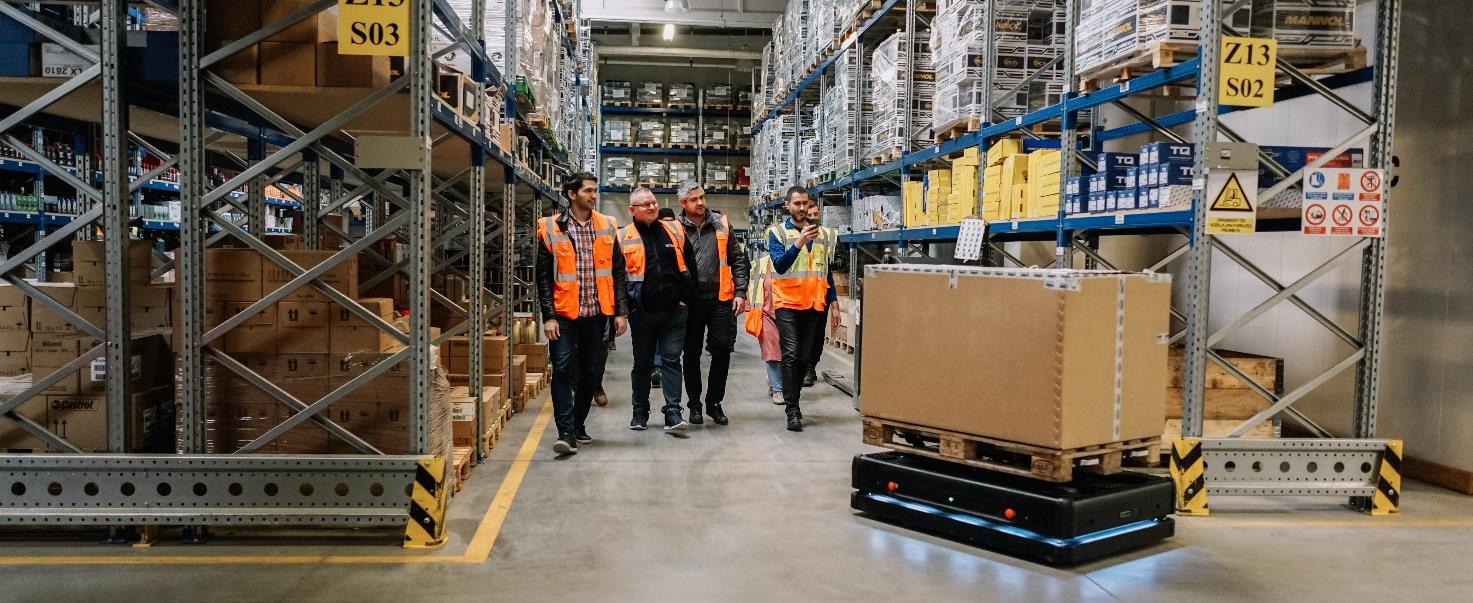
The robot was deployed on real tasks from the first day. In the initial test phase, the robot carried loads between two points in the warehouse. The company explored two uses cases, both using an ‘On Demand’ approach. One use case engaged the robot in service of order fulfillment – delivering articles stored in the warehouse to a packing area near the main loading dock. Workers then took the items and packed them in boxes intended for shipment. The other use case employed the robot to deliver packing material for disposal. The deliveries were initiated by Tokić employees, on demand, through the robot interface application on tablets.
Day one
The project launched on March 18th, 2019, and one robot has been rolled-out at present but more are planned for Q4/2019. On day one, the Gideon’s staff conducted a two-hour set-up process that included manually driving the robot around the warehouse to allow it to make its map of the facility. Once the map was generated and pick-up and drop-off locations input, the robot was ready to operate. Gideon’s staff conducted a training session for Tokić employees.
On-site support
Initially, a Gideon customer success field engineer was on-site, every day, providing technical support, serving as a liaison forwarding user feedback to Gideon’s Robot Interface and development staff. He also performed ongoing reinforcement training, when necessary.
Result
Navigation and localization
- The robot successfully navigated the highly dynamic environment in the Tokić warehouse and distribution center.
- No significant issues with navigation and localization were reported (then or since).
Employee reactions
- Initially, a considerable share of employees showed apprehension, caused to a varying degree by perception of complexity, resistance to change, and a general (and common) misapprehension that robots “take” jobs.
- While the implementation was easy; the human response required managing. Gideon’s staff were aware of the psychological aspects of technology-related change management, and addressed any adverse reactions by focusing on reinforcement training as well as intense listening/responding.
- After the apprehension wore off, employees tested the limits of the robot, challenging its safety requirements to a point. However, this was a limited reaction, also addressed by reinforcement training (e.g., “You wouldn’t jump in front of a moving forklift…”).
By the end of the initial three weeks, the employee stance was overwhelmingly positive. In an impromptu interview, a Tokić warehouse manager speaks of the simplicity, efficiency, and Gideon’s support.
“On the first day, you [Gideon] brought in wires, cables, computers – we all said ‘this will be complicated.’ In fact, when I learned [about it], it’s very easy to use. I mean, creating missions, sending the robot…it’s easy for anyone who knows how to pick up a cell phone to be able to use this robot,” said Tomislav Vonić.
The positive stance is further illustrated by the fact that Tokić staff named to the robot “Zdenka” and devised a system of keeping track of the distances covered by comparison to the distance between Dubrovnik and Ilok, the two Croatian towns that are furthest apart.
Use-cases and usage
- Tokić staff proposed custom modifications to the robot interface which have been implemented, allowing more efficient use.
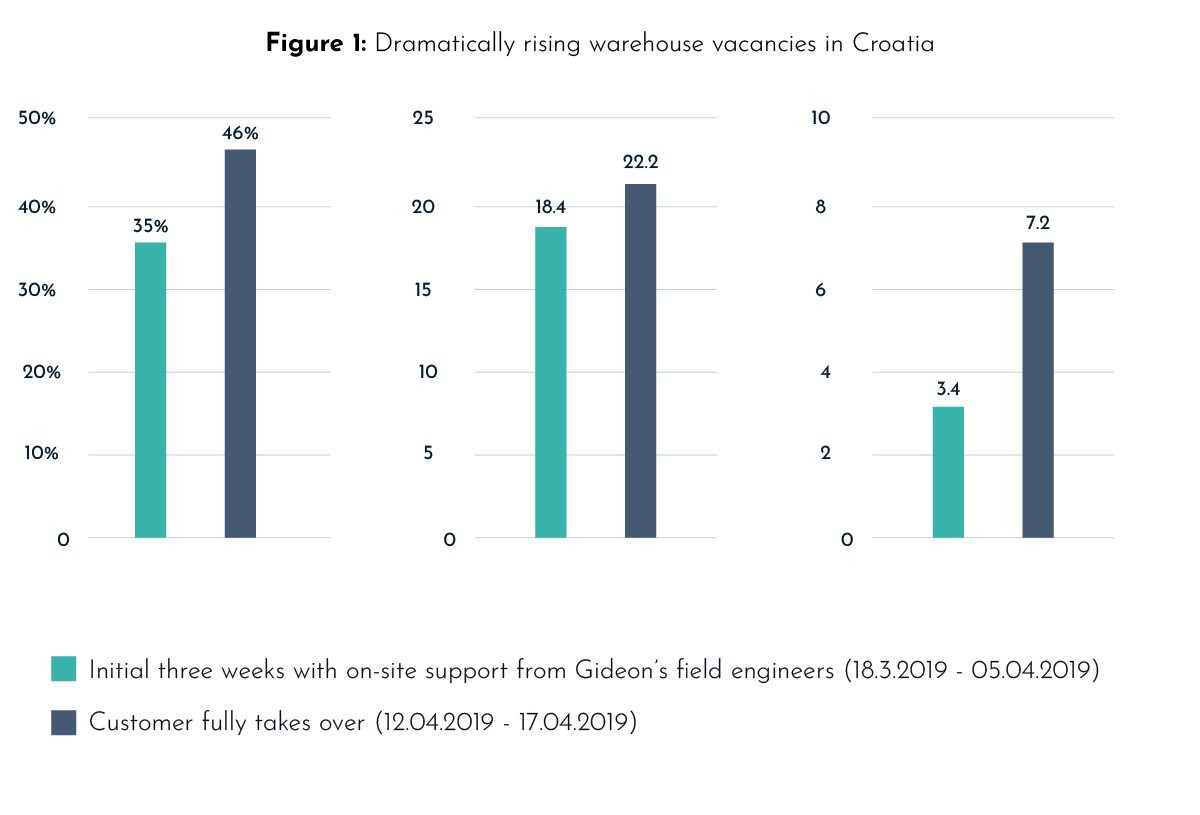
- During the first three weeks, while Gideon’s representatives were present on-site, the average use of the robot was at 34.8% of the total possible time measured in minutes of shift working hours. The average daily distance covered by the robot was slightly over three kilometers.
- The usage significantly increased once Gideon’s representatives left the site, giving full control and operation to Tokić staff. The use of the robot surged to 46.3%, and the average distance covered per more than doubled, to 7.3 kilometers.
- This overwhelming increase after Gideon’s staff was no longer present at the Tokić warehouse, demonstrates that the Tokić team fully embraced the possibilities offered by Gideon’s robot, with the large share of the operations – or ‘missions’ – being those that connect the two remote pick-up and drop-off locations.
Outcome
The client is introducing four more robots before year-end, under Gideon’s Robotics-as-a Service model.