- success-story
DB Schenker: Leveraging growth for a logistics giant and a premium carmaker

Customer
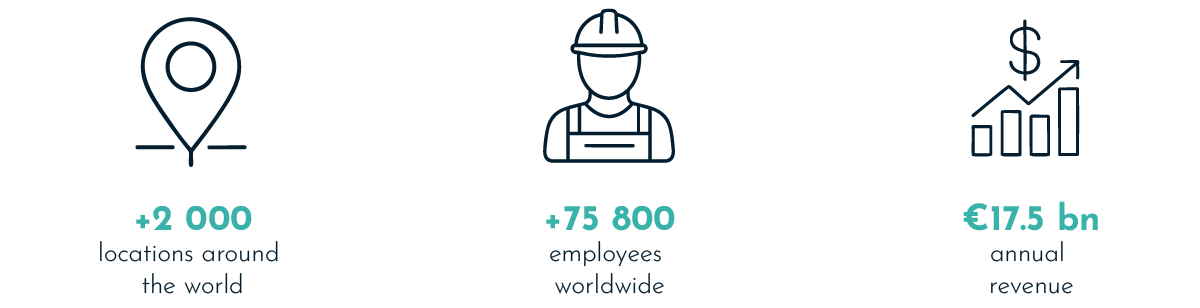
DB Schenker is a global industry leader with over 140 years of logistics experience.
- Land transport
- Air freight
- Ocean freight
- Contract logistics
- Supply chain management
DB Schenker launched a pilot project with Gideon at their facility in Leipzig, which operates as a 3PL logistics center for a prominent German automobile manufacturer. The Leipzig facility is the largest DB Schenker supply center worldwide.
Challenge
DB Schenker’s Leipzig logistics center is their customer’s hub for the supply of car parts to their overseas production facilities. The nature of this contract-logistics partnership underlines the importance of ensuring – and demonstrating – that DB Schenker will continue to provide the highest level of service over the long term.
New technology is one of the few remaining levers for growth in logistics. In warehouses, operations are still predominantly manual, as available automation solutions have so far not proven adequate to warrant widespread deployment. These environments are dynamic and unstructured; a machine must operate safely and efficiently in the space it shares with workers and forklifts constantly shifting incoming and outgoing cargo.
“In our drive to offer strategic advantages for our clients in the increasingly complex digital environment, DB Schenker continuously explores opportunities to integrate innovations from visionary start-up companies. Delivering automation possibilities for logistics and warehouse operations is a foundation for building the next-generation supply chain”
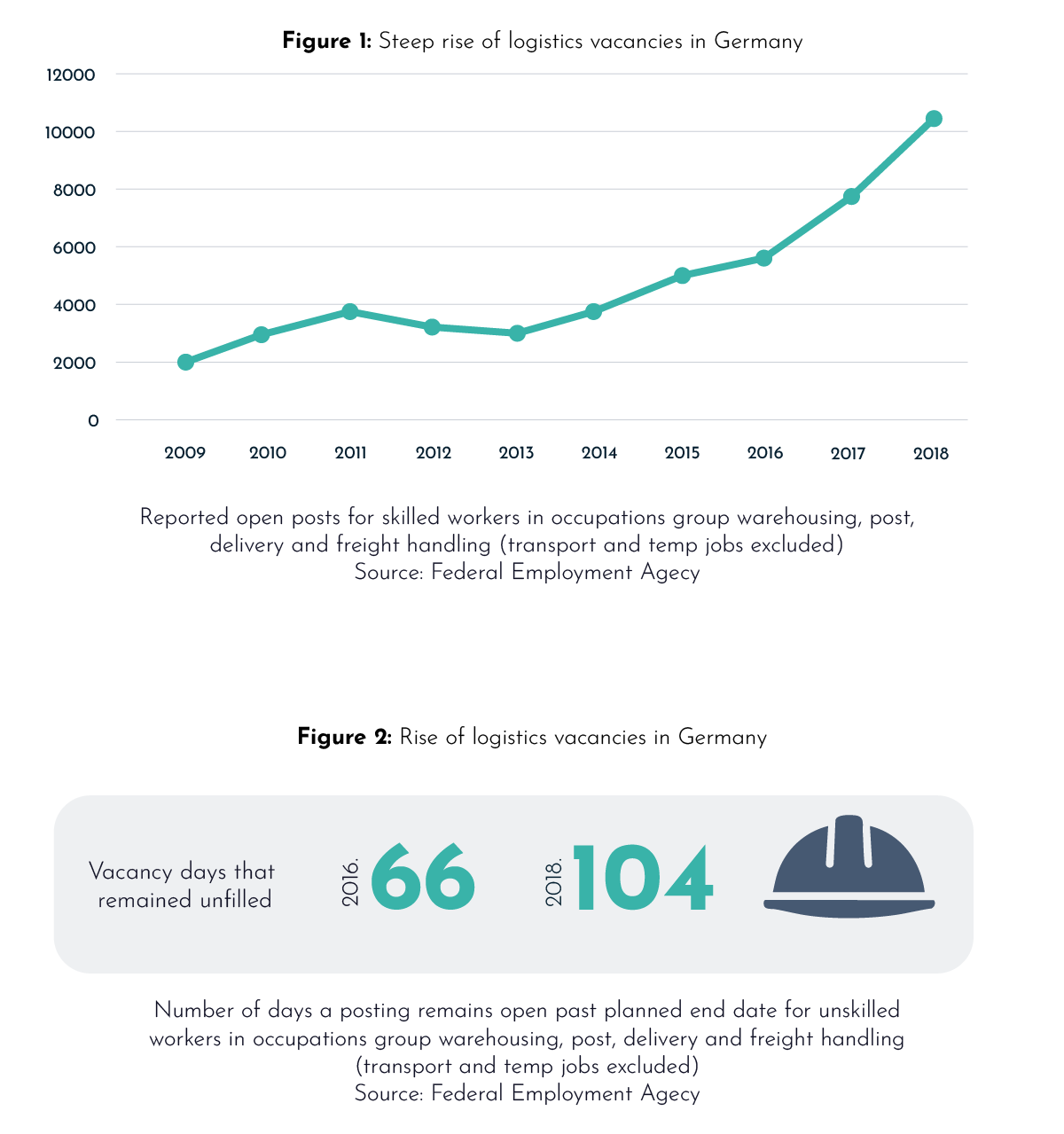
Technology has the potential to alleviate some of the pressures stemming from the labor shortage in logistics, which has been widely reported by European businesses. German employment statistics point to rising demand and longer time needed to fill vacancies.
There is another objective, where results are less measurable but no less significant: enhancing reputation. Implementing cutting-edge technology solutions is one aspect of this process, relevant for all stakeholders, but especially for customers and employees.
“On a daily (basis) we strive to improve our processes concerning efficiency and ergonomics. On the other side, we have to cope with the shortage of workers here in the marketplace. (It is) a kind of reputation also for us to have new technologies here in Leipzig for DB Schenker.
Frank Rother, Branch manager Leipzig
Customer needs
Automation
A solution that increases efficiency and throughput, providing clear advantages and leveraging growth, as well as allowing warehouse employees to focus on value-added tasks and reduce physically demanding and repetitive work.
Flexible implementation
The company is looking for a solution that will allow simple and modular implementation, not requiring changes to the existing infrastructure and one that can be easily scaled.
Consistent in a highly dynamic environment
The customer requires a solution that operates consistently in a highly dynamic, constantly changing environment, sharing the space with employees and moving equipment.
Simplicity of use
Ease of use was seen as a critical requirement, not only to allow a more successful implementation but to address employee insecurities as well.
Showcasing innovative drive
New technologies bring opportunity, and a market leader needs to sustain the innovative drive to demonstrate to their stakeholders – including customers and employees – they are building opportunities for future growth.
Solution
DB Schenker launched a project with the robotics and AI company Gideon Brothers to pilot the firm’s fully autonomous pallet-carrier equipped with advanced, AI-powered visual perception. As part of the pilot, the Leipzig facility deployed three robots. In the run-up to the pilot project, Gideon’s robot passed an acceptance test at DB Schenker’s Leipzig facility – with overwhelming success. The trial focused on localization and obstacle avoidance, and Gideon’s robot successfully passed even the most sensitive task – detecting the forks of an empty forklift, which, in line with safety protocols, must always be placed in the lowermost position. Detecting such low-lying objects is something that few competing solutions relying only on the industry-standard 2D LiDAR sensors can achieve. (An overview of advantages of vision over LiDAR is available here.)
No one at our facility has ever had such synergy or whose technology responded as well during acceptance tests.
Constance Richter, Project manager
The robot
The machine is a collaborative (designed to work around people) logistics robot, a heavy-duty pallet carrier with a load/lifting capacity of 800 kilograms. It is fully autonomous, requiring no guidance systems of any kind: it creates and updates its map, on which operators input pick-up, drop-off, and other points and areas of interest. Its autonomy technology, developed by Gideon, is based on breakthrough visual perception, underpinned by deep learning. Thanks to its visual perception, it outperforms competing technologies in terms of navigation and is safer because it perceives obstacles that are invisible to standard LiDAR (Light Detection and Ranging – or laser) sensors.
The roll-out is simple (a few hours) and modular (just one robot or a fleet). It doesn’t require any significant changes to facilities, and there is an option to integrate the fleet with warehouse management system software. It doesn’t lose time at the charging station – the batteries can be exchanged amid operation. Gideon uses a Robotics-as-a-Service business model – and therefore does not require significant capital expenditures.
Use cases
Robots automate tasks associated with regular order fulfillment, speeding it up and allowing employees to focus on more complex tasks. The use cases developed for the pilot are on-demand, with the robots running between 20 and 30 template missions on demand, at a click of a button by an employee.
The typical template mission orders a robot to bring over a transport box with a new batch of packaging materials to one of the desks where employees are packing orders for shipping. Employees stationed at each of the packaging locations can launch template missions by a few clicks from their terminal. Before the pilot, this task required an employee to drop what they were doing at the time, find a forklift, and bring over new packaging materials before resuming the interrupted work.
Preparation for the pilot
Planning and preparatory activities for which Gideon provided support included:
- Analyzing workflow to determine the best use-cases for the robot,
- Defining relevant KPIs to measure efficiency gains,
- Communication and change management support, including materials such as videos, background information documents (timely and appropriate information for employees is the key to ensuring a positive stance),
- Training,
- Providing user documentation,
- Technical preparation – initial mapping and image data-set collection (the robot was guided through the space to allow the system to map the space and collect images to train the object recognition algorithms)
- Marketing support for both internal and external communications.
Ongoing support
Gideons field engineers provided on-site support, including training, over the first few days, and then stand-by support for the following few weeks. Remote support was available for the duration of the pilot, including requested custom modifications to the fleet management app.
Result
Use-cases and usage
A few weeks into the project, DB Schenker expanded the pilot by adding a significant number of new pickup and drop-off points.
- The total distance covered by robots surged over the first weeks of the project, increasing four times to over 120 km for the three robots before the end of the second month of the project.
- With the increased ‘mileage,’ the use rate doubled over the same period.
- The pilot project minimizes the interruptions to the packing operations (see quote below).
“It’s a great opportunity to improve our processes, efficiency, and ergonomics. Three robots supply packaging material to several packaging places. If the employees have a demand, they have a possibility to press a button, and then one of the robots starts a process by collecting a transport box and transporting, for example, cart boxes to the packaging place. It’s direct information and a direct response from the robots. Normally you have a colleague who transports the pallets and sometimes you have a delay, and that doesn’t happen if you have a robot,”
Frank Rother, Branch Manager Leipzig.
Technology
- The robot localization and navigation showed consistently successful performance in the highly dynamic environment of the DB Schenker Leipzig distribution center.
- Fleet Management application proved to be an efficient and user-friendly interface, allowing different access levels and customizable views.
- DB Schenker staff (operations level, not IT level) performed all ongoing fine-tuning of mission templates, system rules, and points of interest.
Employee reactions
- Gideon staff are aware of the psychological aspects of technology-related change management and supported smooth roll-out by focusing on reinforcement training as well as listening/responding to minimize any adverse reactions.
- Positive stance and involvement of DB Schenker employees is highlighted as a key factor for the successful roll-out:
“It is not just the technical introduction of the equipment which is critical in bringing the pilot project to a successful conclusion, but also the involvement of the employees. Continuous communication and information events have dispelled concerns among DB Schenker employees. New developments are directly and immediately communicated to all affected employees by the project team. It was also the employees who decided upon the names of the three vehicles on site.”
(“Kirk, Spock and McCoy in the warehouse”, Logistik Aktuell, DB Schenker)
- The positive stance is further illustrated by the fact that the staff named the robots after characters from the popular science fiction show Star Trek – Kirk, Spock and McCoy – and asked that the robots play the theme from the series in specific areas instead of the standard alert signal (audio signals are customizable).
Outcome
After the initial three-month period, DB Schenker announced that the pilot was successfully completed and launched a joint communications campaign with Gideon Brothers. DB Schenker is validating Gideon’s technology for further use in a dynamic logistics environment. Discussions on future projects in Leipzig and other locations are ongoing.
“I’d like to thank […] all of the Gideon team members for the successful collaboration on our project in Leipzig. Working with you and the team was really refreshing and motivating! We learned a lot, not only on the technical parts, but we could also experience very successful project management with an external partner. I was glad to hear when the pilot was extended […], as we like working with the robots”
Constance Richter, Project Manager at DB Schenker