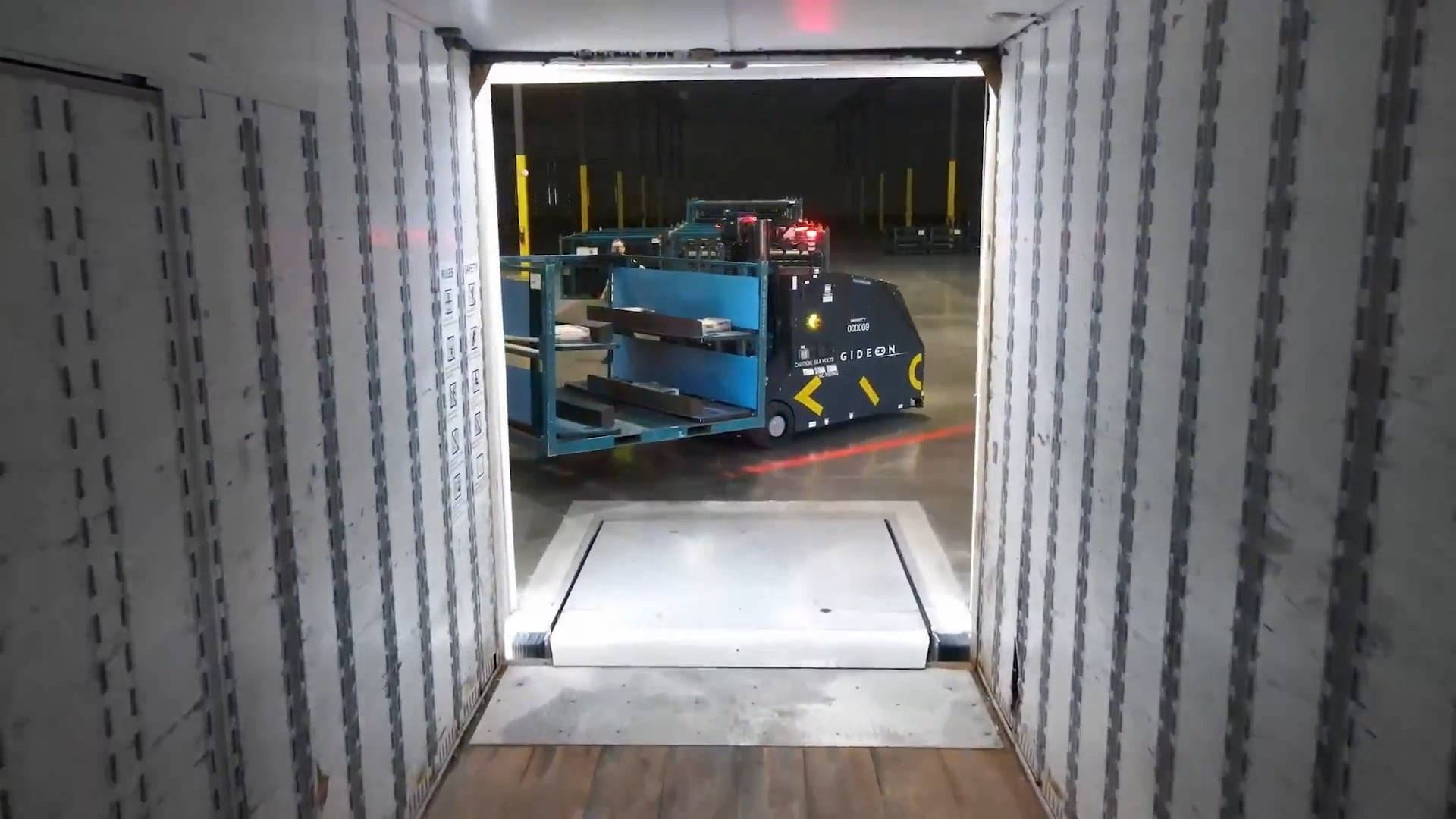
TREY is First Autonomous Forklift to Master Trailer Loading and Unloading from First Pallet to Last
Built on Gideon’s Physical AI Platform, TREY Adapts to Dock, Trailer and Load Variability
BOLINGBROOK, Ill., October 7, 2026 – Trailer loading and unloading remain the most difficult processes to automate in the warehouse because every load, trailer and dock presents different operating conditions. The critical point for inbound and outbound workflows can now be automated with TREY, the only autonomous forklift that can execute trailer loading and unloading from the first pallet to the last.
TREY is now commercially available across North America and deployed in automotive manufacturing plants, food and beverage distribution centers, and third-party logistics (3PL) operations.
“Supply chain operators have been missing out on dock automation simply because automated forklift technology had not delivered on the critical requirements every warehouse needs – the ability to safely load and unload trailers,” said Edin Kočo, Ph.D., Chief Robotics Officer and Co-Founder, Gideon.
“Gideon’s TREY automated forklift has mastered trailer loading and unloading because it possesses advanced physical AI technology to recognize and respond to more variability on the dock than any other solution on the market.”
Designed for warehouses that want to scale automation for large volume demand, the autonomous forklift performs at its peak on loading docks that receive 30 or more trailers per day. It improves operational consistency and resiliency on the dock with the ability to:
Move up to 28 single- or double-stacked pallets or cages per hour, or 224 per eight-hour shift.
Identify and handle more than 119 load carrier types of different sizes and weights.
Work with various trailer styles ranging from dry van, refrigerated, drop deck, intermodal and more.
Charge autonomously between cycles, extending operating time across multiple shifts.
Part of the autonomous trailer loading/unloading forklift category, TREY is an autonomous mobile robot (AMR) and is available in medium- and heavy-duty models to match the demands of manufacturing plants or warehouses. The heavy-duty model can move industrial parts and components with its payload of 6,000 pounds and operating time of 10 hours on one battery charge. The medium-duty model can carry a payload of 3,500 pounds and operate for 12 hours on one battery charge.
Physical AI Creates Consistent, Repeatable Dock Automation
TREY operates on Gideon’s physical AI platform that combines image-based perception technology with sensor fusion to interpret its surroundings. The company’s vision module, designed in-house, uses a two-camera stereoscopic system to gather depth information and provide context about objects in the path or perimeter of the forklift.
“Systems that only use 3D LiDAR can determine an object’s location and distance away,” said Kočo. “Image-based perception adds meaning and context to recognize the type of load carrier, including its orientation and whether it needs to be repositioned before loading or unloading so that TREY knows what to do next. That’s the level of detail the Gideon physical AI platform provides.”
Using neural networks, machine learning and its vision module, the automated forklift recognizes and responds to changing conditions during loading and unloading, including:
Dunnage – The forklift can detect bulkhead insulation, air, or dunnage bars or belts in the trailer and notify an associate to remove it. When dunnage is needed during loading, TREY pauses outside the trailer until an associate adds it and confirms the automation can proceed.
Orientation Patterns – Inbound trailers arrive with pallets in varying arrangements. TREY can recognize different orientations and rotate pallets as needed during unloading. For loading, multiple patterns can be preconfigured in advance for a fast and efficient process.
Other Objects – TREY’s perception system recognizes more than 30 other objects common on the warehouse floor, such as equipment, people, racks and barriers. Its real-time autonomy software uses the information to plan movements on the floor, improving safety and reducing product damage and loss.
Dynamic Staging – When the dock is congested, the autonomous forklifts can share staging areas with manual forklifts, instead of stopping and waiting an entire trailer cycle to restart. As pallets move and space opens up, automated loading or unloading continues without waiting for the full lane to clear.
“Gideon’s TREY automated forklift has mastered trailer loading and unloading because it possesses advanced physical AI technology to recognize and respond to more variability on the dock than any other solution on the market.”
Edin Kočo, Ph.D.
Autonomous Safety Systems With 360-Degree Awareness
TREY’s first operational goal is safe movement around people, equipment and inventory. It uses two laser scanners to create a 360-degree safety field around the forklift, while safety zones automatically adjust to changing operating conditions. An embedded safety controller continuously monitors safety-related inputs and can trigger immediate stops. The forklift is equipped with six emergency-stop buttons plus a remote control stop button an associate can use to immediately discontinue operations.
The system complies with the Safety Standard for Driverless, Automatic Guided Industrial Vehicles and Automated Functions of Manned Industrial Vehicles from the American National Standards Institute (ANSI/ITSDF B56.5-2019) as well as ISO 3691-4:2023 for Industrial Trucks: Safety Requirements and Verification Part 4: Driverless Industrial Trucks and Their Systems.
Consistent Dock Automation Reduces Complexity, Increases Insights
No expensive changes to the facility, dock, or trailers are required to implement TREY autonomous forklifts and every deployment comes standard with fleet management software and an analytics dashboard that give dock managers tools to validate the automation’s performance.
Fleet management software coordinates the robots as they serve multiple dock doors in the facility. The software integrates with Warehouse Management Systems (WMS), Warehouse Execution Systems (WES), or stands alone.
The Fleet Intelligence Dashboard collects and presents operational data from the automated forklifts, including how many trailers have been loaded or unloaded, the speed and performance of the robots and the number of associate interactions needed to support the work. Warehouse teams can use the information to compare performance between shifts, recognize patterns, or identify training needs.
As pallets are loaded and unloaded, TREY captures time-stamped images that provide an audit trail for the inventory.
About Gideon
Gideon develops the physical AI platform for autonomous operations in warehouses and manufacturing facilities. The Gideon proprietary physical AI platform is the automation foundation for modern logistics, helping supply chains become safer, more predictable, and free from the constraints of manual labor.
Its flagship product, TREY, is the first and only automated forklift capable of both trailer loading and unloading and is deployed at automotive manufacturing plants, food and beverage distribution centers, and 3PL operations to fully realize dock automation.
The company is backed by $75 million in venture funding and has a long-term partnership with Toyota Industries to expand the reach of physical AI into the warehouse and enhance the capabilities of autonomous robots.
Gideon has a unique trans-Atlantic structure that pairs U.S. manufacturing with Croatian R&D expertise to deliver robust customer value. The company has headquarters and testing facilities in both Bolingbrook, Illinois and Osijek, Croatia. www.gideon.ai