Leveraging Physical AI to Create the Autonomous Loading Dock of the Future
The Story of Gideon, and Collaboration with Toyota Material Handling Europe, SoftServe and NVIDIA
Deploying physical AI is not about proving technology in controlled environments – it is about solving the toughest operational challenges in the field, in real-world customer facilities. In these production environments, variability is constant, on-time and in-full delivery are required, people and equipment are constantly on the move, and safety is non-negotiable. One of the most demanding warehouse areas is the loading dock, where trailers are unloaded and loaded.
Autonomous Trailer Unloading and Loading (ATUL) was traditionally limited to environments where variability was tightly controlled. Solutions depend on predefined loading patterns, standardized pallets, fixed trailer types, predictable conditions and expensive to change infrastructure. As a result, production deployments were highly limited and confined to food, beverage, and consumer packaged goods operations, while more complex and variable industries or operations further down the supply chain remained out of reach.
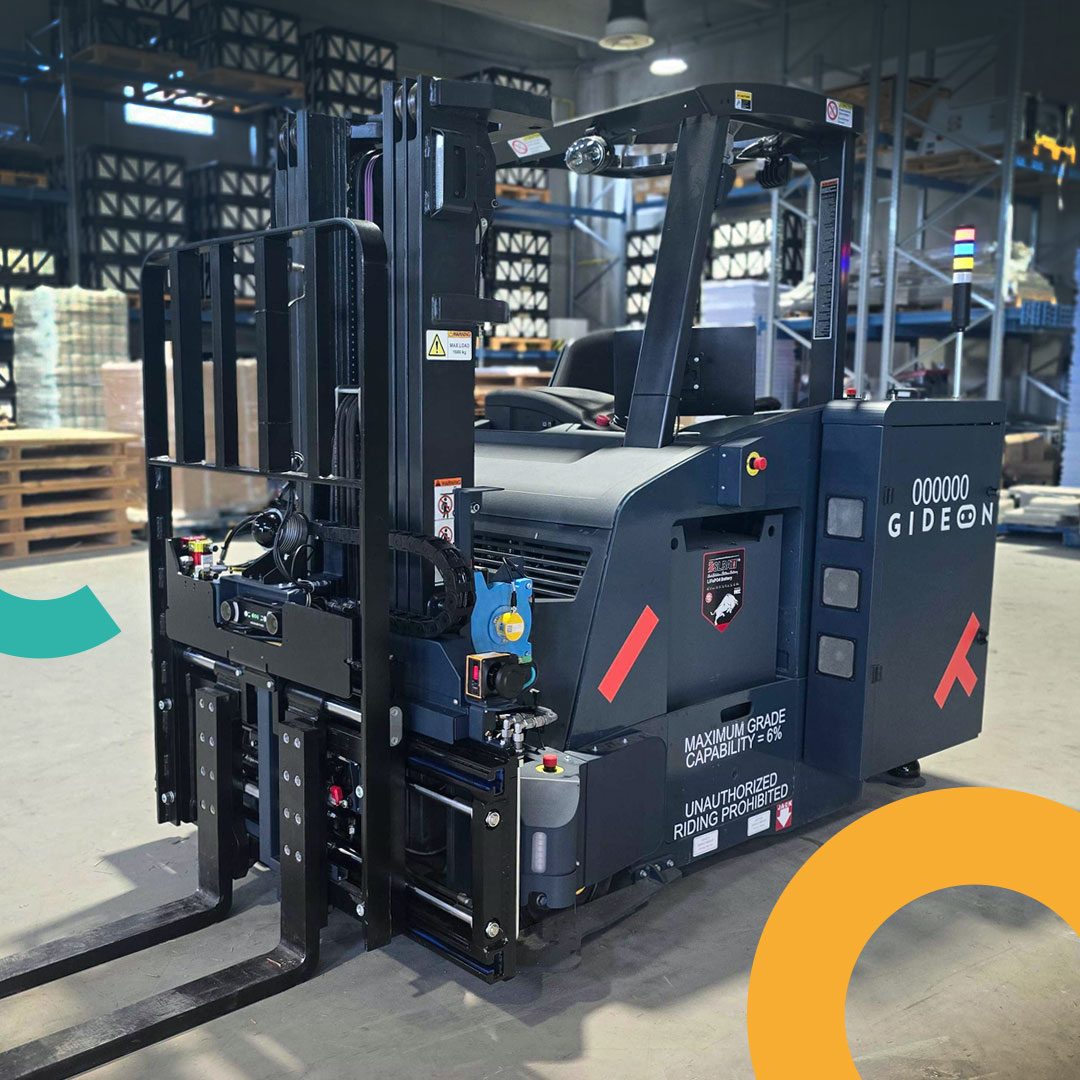
Gideon, a leading provider of AI and vision-based autonomous mobile robots (AMRs), has developed and delivered a transformational shift in ATUL enabling production deployment of a fully autonomous mobile robot fleet capable of handling non-predictive inbound and outbound operations across different industries, but most notably in the automotive industry – one of the most demanding logistics environments, due to its high variability and low tolerance for downtime.
“These deployments mark a major milestone that proves loading bay transformation is possible in mission-critical, always-on operations in the automotive sector. It validates the physical AI approach of tight coupling of proprietary sensors (Gideon’s Vision Modules) and hardware design with AI based autonomy platform built on top of the NVIDIA ecosystem.” said Josip Cesic, CEO and Co-founder of Gideon.
By tightly coupling material handling equipment with proprietary perception hardware (Vision Modules), real-time autonomy software, and dock operational intelligence, Gideon was able to develop its flagship product, Trey, for ATUL that transforms manual, operator-dependent dock workflows into fully autonomous inbound and outbound operations.
Proprietary hardware and software, powered by NVIDIA AI infrastructure including NVIDIA Jetson Xavier NX and NVIDIA RTXGPUs, that are used in this application are allowing Trey to have a human-like perception to understand and act differently based on context and minute differences in load types, pallet placement, and environmental conditions.
With deployments across various industries in North America, the system has proven reliable and capable of coping with the variability and unpredictability of the real world.
At an industry level, the work done by Gideon breaks a long-standing barrier that has limited Autonomous Trailer Loading and Unloading applicability to the entire supply chain, constraining the true loading bay transformation from happening.
By demonstrating production-level autonomy in automotive logistics – arguably one of the most complex dock environments – it establishes a new benchmark for flexibility, safety, and integration–and marks a true transformation of the loading bay that is scalable. This will allow and accelerate the adoption of robotics across the supply chain in operations that were previously considered “too complex” to automate.
Toyota Material Handling Europe, SoftServe & Gideon: Collaborative Case Picking
Building on top of autonomous trailer loading and unloading, Gideon has expanded its Autonomy software to other applications through partnerships. The most prominent example is a current live collaboration between Toyota Material Handling Europe, SoftServe, NVIDIA and Gideon to bring automation to one of the hardest use cases in logistics: case picking.
Toyota uses Gideon’s autonomy and case picking optimization logic on its vehicles and in combination with its broader warehouse automation portfolio to offer collaborative case picking solutions that help customers increase operational efficiency, especially at their brownfield sites that struggle with throughput and labor retention.
“Collaborative case picking is one of the most demanding warehouse applications because it requires autonomous systems to operate safely and predictably alongside people in live production environments. By integrating Gideon’s autonomy with our industrial vehicles and validating performance through simulation before deployment, we are bringing Physical AI into real customer operations.”
— Patric Hed, SVP Logistics Solutions, Toyota Material Handling Europe
To ensure these vehicles can be deployed efficiently and reliably, Toyota adopts a simulation-driven development approach. Digital twins of vehicles and customer sites are used to validate system behavior, reduce commissioning time, and minimize disruption during on-site deployment.
SoftServe supports Toyota Material Handling Europe by creating and maintaining these simulation environments, developing detailed digital representations of warehouses, vehicles, sensors, by leveraging NVIDIA Omniverse libraries and the NVIDIA Isaac Sim framework.
Once the simulation environment confirms and validated performance, deployments focus on collaborative case picking in live production warehouse operations and not controlled lab environments. In this active picking operation, human workers and autonomous vehicles operate side by side, requiring human-like perception, safe navigation, and real-time decision-making.
Toyota Material Handling Europe is actively deploying the Collaborative Case Picking solution with chosen customers across Europe in 2026. These deployments demonstrate the impact of Physical AI on automation and how it only succeeds when hardware and software are tightly integrated and validated as a single system.
Across both collaborative case picking and autonomous trailer loading, NVIDIA technology underpins the full Physical AI lifecycle.
Simulation and validation are performed in environments built on NVIDIA Omniverse libraries and NVIDIA Isaac Sim, enabling teams to model edge cases, human interactions, and safety-critical scenarios before systems are deployed. On the vehicles themselves, proprietary camera-based vision modules powered by NVIDIA Jetson Xavier NX provide low-latency AI perception, while onboard computers equipped with NVIDIA RTX GPUs run real-time autonomy.
In addition, Gideon’s autonomy systems rely on NVIDIA CUDA and NVIDIA TensorRT to meet the strict latency, safety, and reliability requirements of industrial operations.
About Gideon
With entities in North America and Croatia, EU, the robotics and AI solutions company specializes in automating material handling processes for logistics, manufacturing, and retail businesses. Its autonomous mobile robots are powered by proprietary spatial AI and 3D vision technology, enabling businesses to automate the most complex warehouse and manufacturing operations and orchestrate workflows of humans, robots, and other equipment supported by real-time data. www.gideon.ai