Automotive manufacturing runs on precision, timing, and an uninterrupted flow of materials. Yet the loading dock—where trailers, forklifts, and people converge—remains one of the most unpredictable points in the internal supply chain. High variability in trailers, dock equipment, and packaging variability, along with tight schedules, rising labor costs and safety risks create daily challenges for high-volume plants.
To sum it up, the need for reliable, flexible dock automation in automotive material handling is crystal clear.
Following the logic mentioned in the intro, a major automotive OEM recently set out to modernize this environment inside one of its assembly facilities, a site larger than 1.5 million square feet operating twenty hours per day, 365 days per year. With tens of thousands of vehicles produced annually, dock performance directly influences the stability of downstream assembly. The OEM sought a flexible, safety-first automation layer; something that could be introduced into live operations without disrupting just-in-time requirements.
Solution
Before we dive deeper into the implementation details, here’s a video of how it all looks:
TREY in action
This video footage demonstrates TREY’s ability to handle the complexity and variability that define modern dock automation in the automotive sector.
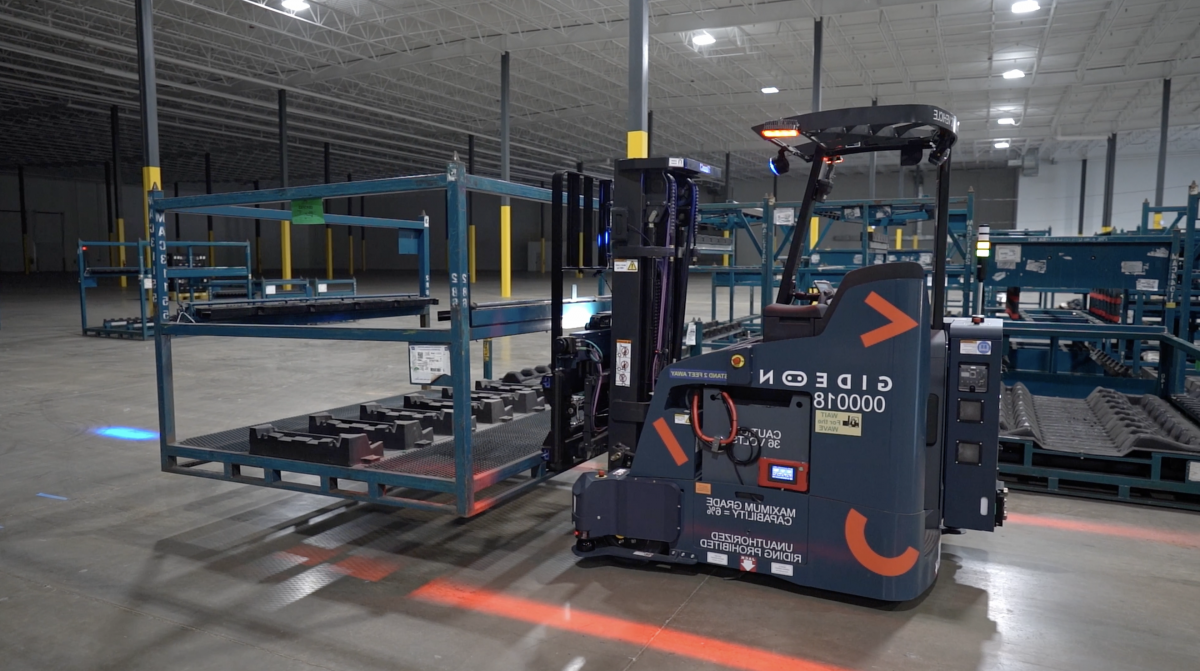
After conducting a successful pilot, the major automotive OEM deployed five Gideon TREY autonomous forklifts, integrating them with automated dock doors and simplified mission management. TREY’s AI-driven, 3D-vision navigation enables the system to recognize and manipulate a wide range of automotive racks, enter and exit trailers with precision, and maintain consistent performance across shift changes and equipment variations.
Purpose-built for the realities of material handling, TREY handles wide and tall carriers, drop-deck and standard trailers, and tight entry zones that leave little margin for error. Continuous operation is supported by opportunity-based charging that keeps the fleet productive across multi-shift schedules—an essential advantage for high-volume dock automation.
Results
Introducing autonomous forklifts into a live, high-demand dock environment generated considerable impact:
Reduced manual touches of freight, lowering operator exposure to high-risk tasks inside trailers.
Less product and equipment damage, enabled by repeatable, vision-guided maneuvering.
More predictable material flow to staging and final assembly, strengthening line stability.
Lower overall operating costs, as repetitive trailer cycles transitioned from manual labor to autonomous execution.
The deployment also connected shipping and receiving into a more unified operation. TREY’s analytics improved visibility into throughput, mission timing, and bottlenecks—allowing the plant to identify new optimization opportunities.
A scalable foundation for autonomous material handling
One of the most valuable insights from the deployment was the demonstration that high-impact automation doesn’t require full enterprise integration on day one. TREY’s modular architecture allowed the Major Automotive OEM to begin with dock operations, prove ROI, and then evaluate further expansion.
With reliable performance now established, the OEM is positioned to explore wider use cases in areas such as aftermarket parts, body-in-white, stamping, and powertrain assembly—creating a blueprint for scalable, flexible automotive material handling across the enterprise.
Setting new standards at the dock
For the Major Automotive OEM, integrating TREY into dock operations delivered safer processes, more predictable material flow, and more efficient use of skilled labor. Automotive material handling is evolving rapidly, and autonomous solutions are no longer a distant milestone—they are an operational advantage today.